WRITTEN BY

Hiren Mansuriya
Director & CTO
AI agents can search data, call APIs, update records and complete workflows. A chatbot may give a wrong answer. An agent can turn that error into a real business action.
The governance gap is already affecting adoption. Gartner predicts that by 2027, 40% of enterprises will demote or decommission autonomous AI agents after governance problems are discovered following production incidents.
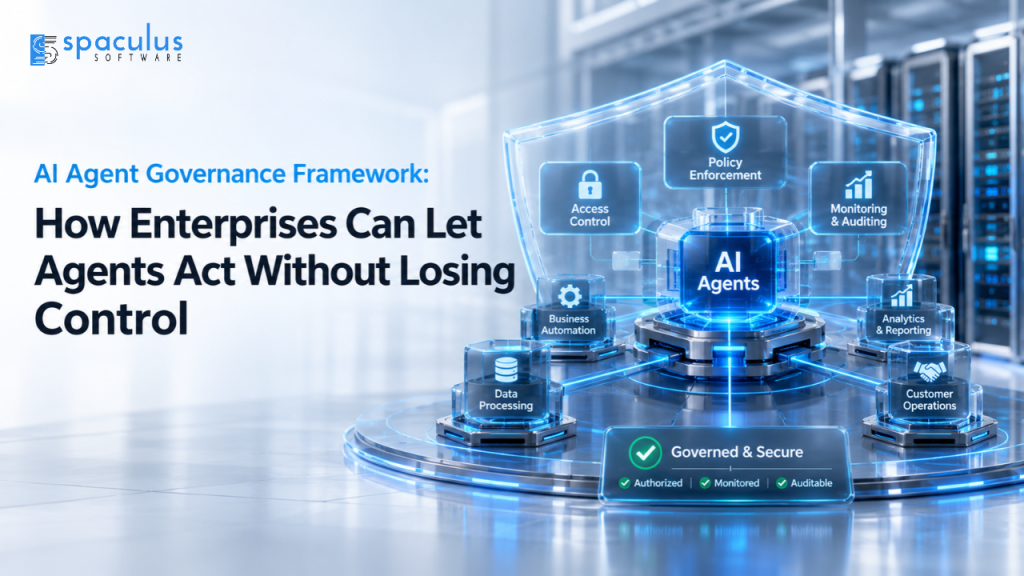
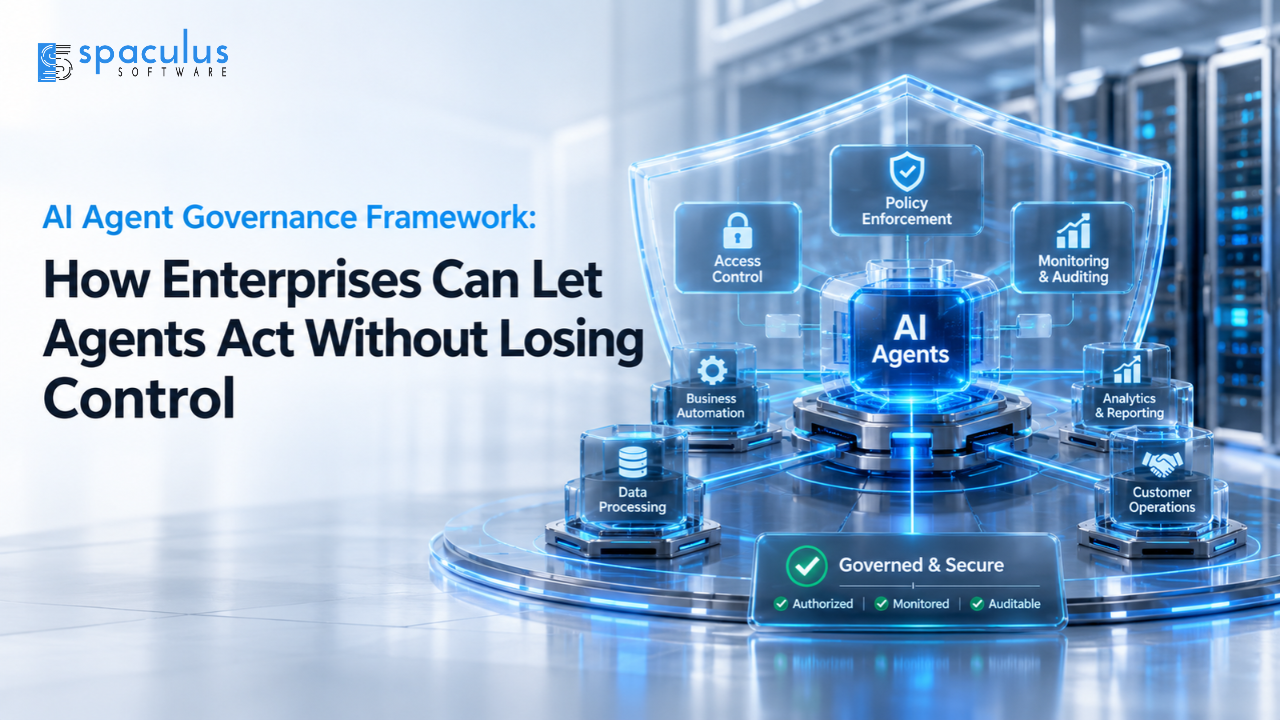
An effective governance framework controls what an agent can access, which actions it may take and when a person must intervene. It keeps autonomy inside enforceable boundaries.
Every enterprise AI agent needs a named owner, distinct identity, limited permissions, risk-based approval rules, action logs, operating limits and a tested shutdown process.
Controls should become stronger as an action becomes harder to reverse. Reading an approved document may require logging only. Sending money, deleting data or changing production should require explicit human approval.
Traditional AI governance often focuses on output quality. Teams ask whether a model’s answer is accurate, safe and based on approved information.
Agents add execution. They can plan, choose tools, retain memory and act across several systems. They may use delegated credentials or exchange instructions with other agents. Prompt instructions alone cannot control these capabilities.
NIST’s AI Agent Standards Initiative focuses on security, identity, authorization and evaluation. The central question is no longer only, “Was the answer correct?” It is also: “Was this agent authorized to act?”
Before selecting a governance platform, define each agent’s action envelope: the approved boundary within which it can operate. It covers purpose, ownership, identity, data, tools, prohibited actions, limits, approvals and retirement.
For example, a customer-service agent may read an order and draft a reply. It might issue refunds below $50 after customer verification. Larger refunds would require human approval.
Without an action envelope, governance becomes a policy document that cannot reliably control runtime behavior.
Not every action needs the same oversight. Requiring approval for every search would make an agent too slow. Allowing every action without review would create unacceptable risk.
| Action level | Enterprise example | Recommended control |
| Observe | Read a policy or check inventory | Authorized access and logging |
| Recommend | Draft a reply or suggest a purchase | Human review before execution |
| Reversible | Update a CRM field or create a ticket | Validation, permission check and rollback |
| Consequential | Send money, delete data or change production | Human approval and stronger authentication |
| Prohibited | Access an unapproved system | Deny, stop execution and raise an alert |
Singapore’s Model AI Governance Framework for Agentic AI also recommends bounding autonomy and tool access, using meaningful approval checkpoints and keeping people accountable.
A current ServiceNow and OpenAI integration shows how this can work. ChatGPT provides reasoning and conversational access, while ServiceNow supplies enterprise context, business rules and permissions. Actions remain executed and governed inside ServiceNow.
An agent should not inherit an administrator account simply because it completes several tasks. Give it a distinct identity and limit permissions according to its purpose, tools, data scope and user context. Check authorization before each action, not only when a session begins.
NIST’s October 27, 2026 design tenets recommend verifiable agent identities, traceable delegation and little or no standing privilege while an agent is idle. This makes actions easier to attribute and limits the damage from compromised agents.
Microsoft’s AI agent shared responsibility model similarly recommends least-privilege tool access, per-action authorization, human approval for high-impact tasks and action auditing.
Governance should control the workflow, not only the final response. Limit how many steps an agent may take, which tools it may combine, how much it may spend and how long it may continue before escalation. Detect loops before repeated calls create cost or duplicate actions.
Treat tool inputs and outputs as untrusted. Malicious instructions may enter through an email, document, website, API response or MCP server. Prompts can guide behavior, but they cannot replace permission checks, application rules and approval gates.
A standard log may show that an API was called. A decision receipt should explain why. For important actions, record the agent and user identities, original request, policy applied, data and tools used, approval status, result, time and correlation ID.
This evidence helps locate failures in the model, authorization, tools, data or business rules. Logging policies should define what must be masked, retained or deleted.
Before production, test scenarios that challenge the controls:
If the team cannot switch an agent off in five minutes, it is not ready for production.
Begin with limited users, data and permissions. Expand autonomy only when monitoring shows reliable behavior. Watch for unusual tool use, permission changes, repeated actions, rising costs, policy violations and goal drift.
Changing the model, adding an MCP server, expanding data access or introducing another agent should trigger a new review. At retirement, revoke credentials, remove integrations and preserve any evidence required for audit or investigation.
Confirm that the agent has:
Before approving a project, ask how the agent’s identity and delegated authority will work. Confirm which systems it can access, whether every action is authorized, which actions require approval, what appears in logs and how unsafe tool output is handled.
The partner should also demonstrate how repeated actions are stopped and how the agent can be disabled or rolled back. “The prompt tells it not to do that” is not an adequate control.
Governance works best when it is designed into the system instead of added after development.
Spaculus Software supports enterprise AI development involving AI agents, business-system integrations, approval gates, monitoring and secure architecture. Organizations can also hire AI engineers to build controlled workflows around CRM, ERP, finance, support and internal data systems.
The objective is to give agents enough authority to create value without giving them uncontrolled access to the business.
It is a combination of policies, technical controls, ownership rules, monitoring and evidence that determines what agents may access, decide and do throughout their lifecycle.
No. Low-risk and reversible actions can often run automatically. Human approval should focus on sensitive, consequential, irreversible or unusual actions.
General AI governance covers data, models, outputs, privacy and accountability. Agent governance also covers identity, delegated authority, tool permissions, runtime actions, memory, rollback and shutdown controls.
Business leadership, engineering, security, data governance, legal and operations should participate. Each agent still needs one named owner.
Hire AI EngineersHiren, a visionary CTO, drives innovation, delivering 300+ successful web/mobile apps. Leading a 70+ tech team, Hiren excels in DevOps, cloud solutions, and more. With a top-performing IT Engineering background, Hiren ensures on-time, cost-effective projects, transforming businesses with strategic expertise.